
UAE Trusted E-Invoicing Solution
E-invoicing
What is E-Invoicing?
E-Invoicing is a secure digital method of creating, exchanging, and processing invoices in a structured electronic format. Unlike traditional invoices shared as PDFs, scanned copies, or emails, e-invoices are generated in a machine-readable format that enables seamless data exchange between business systems. This improves accuracy, reduces manual intervention, and helps organizations streamline their invoicing processes while maintaining compliance with UAE regulations.
As part of the UAE’s digital transformation initiative, e-invoicing is set to become a key component of tax and financial reporting. Businesses can benefit from faster invoice processing, improved VAT compliance, enhanced data security, and greater operational efficiency. By adopting e-invoicing solutions, organizations can automate financial workflows, reduce administrative costs, and prepare for future regulatory requirements in the UAE.

Why E-Invoicing?
The UAE’s e-invoicing initiative is designed to accelerate digital transformation, improve tax transparency, and enhance business efficiency. By enabling the secure exchange of structured electronic invoices, businesses can streamline financial processes, reduce manual errors, and maintain greater compliance with regulatory requirements.
Beyond compliance, e-invoicing helps organizations optimize operational performance through faster invoice processing, lower administrative costs, and improved data accuracy. It also supports sustainability goals by reducing paper-based transactions while creating a more connected and digitally driven business ecosystem.
Why E-Invoicing Matters for Businesses
Secure, compliant, and efficient e-invoicing solutions designed for modern UAE businesses. Get in touch →
Improved VAT Compliance
Ensures accurate tax reporting and helps businesses meet UAE VAT requirements with greater efficiency.
Enhanced Business Efficiency
Automates invoice processing, reduces manual tasks, and improves operational productivity.
Increased Security
Protects invoice data through secure digital exchange, reducing fraud and unauthorized access risks.
Faster Invoice Processing
Accelerates invoice validation, approval, and payment cycles for improved cash flow management.
Cost Reduction
Minimizes paper usage, storage expenses, and administrative costs through digital automation.
Upcoming Mandate
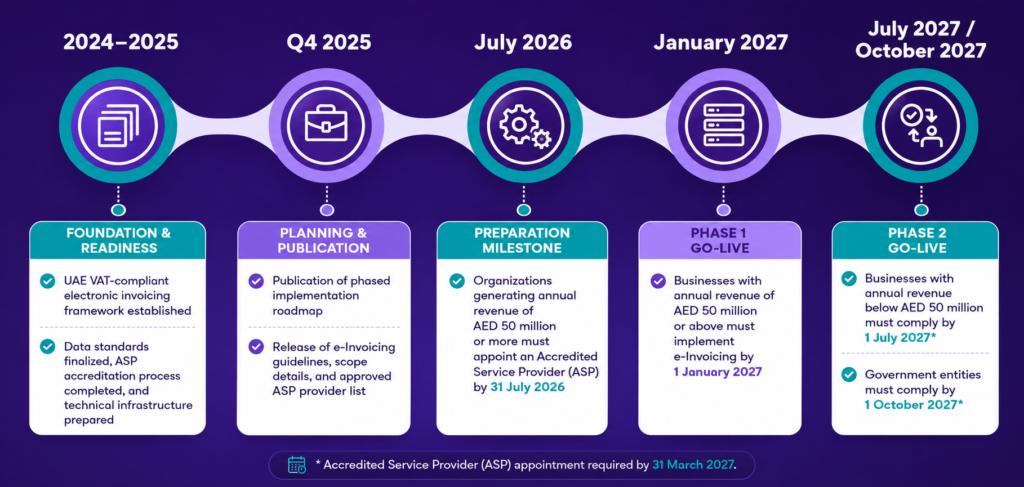
Starting July 2026, the UAE will begin Phase 1 of its national e-invoicing rollout through a pilot programme involving selected businesses. The initial phase will focus on business-to-business (B2B) and business-to-government (B2G) transactions, with mandatory adoption commencing from 1 January 2027 for eligible entities.
As the implementation progresses, the e-invoicing mandate is expected to expand to additional businesses and sectors, supporting the UAE’s vision for a more transparent, efficient, and digitally connected economy.
Exclusions
The e-Invoicing mandate applies to most B2B and B2G transactions, with the following exceptions:
Sovereign Government Activities
Government entities performing official functions and responsibilities in their sovereign capacity under applicable regulations.
International Passenger Transportation
International passenger travel services supported by electronic tickets and related airline services provided directly to travelers.
Air Cargo Transportation
International air freight services documented through air waybills, covered under a temporary implementation exemption period.
VAT-Exempt & Zero-Rated Financial Services
Financial services classified as VAT-exempt or eligible for zero-rating under applicable VAT regulations.
Business-to-Consumer (B2C) Transactions
Transactions conducted directly with end consumers that currently remain outside the mandatory e-Invoicing scope.
How Does e-Invoicing Work?
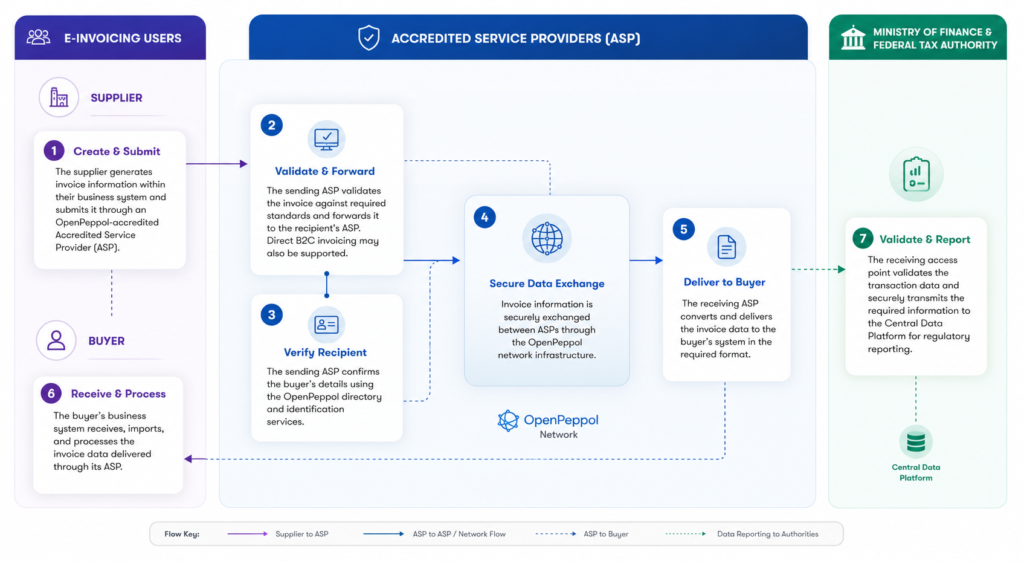
1. Supplier submits e-invoice to ASP (Corner 2).
2. ASP validates and forwards invoice to buyer’s ASP (Corner 3).
3. Tax Data Document (TDD) is reported to the Central Data Platform.
4. Buyer’s ASP validates the invoice and returns status confirmation.
5. Invoice is delivered to the buyer and tax data is reported.
6. Central Data Platform issues confirmation messages.
7. Supplier receives status updates through Corner 2.
8. Buyer receives status updates through Corner 3.
How Yuga Accounting Can Help
To comply with the UAE’s e-Invoicing regulations, businesses need to ensure their accounting and ERP systems are prepared for seamless integration with the national e-Invoicing framework. At Yuga Accounting, we provide end-to-end support to help organizations successfully adopt e-Invoicing, maintain regulatory compliance, and improve operational efficiency. By taking a proactive approach, businesses can minimize disruption, streamline processes, and confidently meet upcoming compliance requirements.
Our team of e-Invoicing and compliance specialists works closely with businesses to assess existing systems, identify readiness gaps, and implement tailored solutions that align with UAE regulations. From selecting the right Accredited Service Provider (ASP) to system integration, compliance advisory, and staff training, we provide practical guidance throughout the entire transition journey. Partner with Yuga Accounting to simplify your e-Invoicing implementation and achieve a smooth, compliant, and future-ready digital transformation.
GET STARTED TODAY
Request A Free Quote
Planning for UAE e-Invoicing compliance? Share your requirements and receive a personalized quotation with expert guidance and implementation support.